

CIA Induction in DBA/1 Mice
Recommended protocol for use with:
- Hooke Kit™ Chicken Collagen/CFA Emulsion (EK-0210)
- Hooke Kit™ Chicken Collagen/IFA Emulsion (EK-0211)
- Hooke Kit™ Bovine Collagen/CFA Emulsion (EK-0220)
- Hooke Kit™ Bovine Collagen/IFA Emulsion (EK-0221)
(See “Kit selection” section below for more information.)
Summary
DBA/1 mice develop collagen induced arthritis (CIA) after immunization with type II collagen emulsified in complete Freund’s adjuvant (CFA), followed by a booster dose of collagen emulsified in either incomplete Freund’s adjuvant (IFA) or CFA 18 to 21 days later.
Maximum arthritic score will be 10 to 14 (on the scale of 0 to 16) for most mice.
When using chicken collagen, CIA will develop 20 to 35 days after immunization in 90 to 100% of male and female mice (Taconic Biosciences).
When using bovine collagen, CIA will develop 20 to 35 days after immunization in 90 to 100% of male and 60% to 100% of female mice (Taconic Biosciences).
Typically, mice are observed for 35 to 60 days.
Kit selection
We generally recommend bovine collagen kits (EK-0220, EK-0221) for male mice and chicken collagen kits (EK-0210, EK-0211) for female mice. While both kits will work in either sex, following this recommendation yields more reliable CIA induction.
The collagen booster dose can be administered in IFA (EK-0211, EK-0221) or CFA (EK-0210, EK-0210). Administration in CFA will result in earlier and more synchronized CIA onset and more severe CIA than administration in IFA (see “Expected results”, below). Dosing stress tends to delay CIA onset and decrease its incidence and severity. If significant stress is expected (for example, daily dosing with a potential therapeutic), we recommend administration of the booster in CFA to obtain more consistent CIA. The booster dose must use the same antigen (chicken or bovine collagen) as the initial immunization.
Each kit contains sufficient emulsion to immunize or boost 20 mice.
Materials needed
For immunization with chicken type II collagen:
| Qty | Description |
|---|---|
| 1 | Hooke Kit™ Chicken Collagen/CFA Emulsion (EK-0210) |
| 1 | Hooke Kit™ Chicken Collagen/CFA Emulsion (EK-0210) or Hooke Kit™ Chicken Collagen/IFA Emulsion (EK-0211) |
| 20 |
DBA/1 mice, males or females (not provided with kit) 7 to 9 weeks old (Taconic Biosciences model DBA1BO) |
For immunization with bovine type II collagen:
| Qty | Description |
|---|---|
| 1 | Hooke Kit™ Bovine Collagen/CFA Emulsion (EK-0220) |
| 1 | Hooke Kit™ Bovine Collagen/CFA Emulsion (EK-0220) or Hooke Kit™ Bovine Collagen/IFA Emulsion (EK-0221) |
| 20 |
DBA/1 mice, males or females (not provided with kit) 7 to 9 weeks old (Taconic Biosciences model DBA1BO) |
See “Kit selection” section above for booster selection.
Mice
Hooke has tested CIA induction in mice from several US breeders. Hooke recommends use of Taconic Biosciences DBA1BO mice with these kits. Taconic mice show the highest CIA incidence and severity in our tests; results may differ in mice from other breeders.
Mice should be 7 to 9 weeks old at immunization. Older and younger mice develop less severe CIA.
Mice must be acclimated to your facility for at least 7 days before immunization.
Either male or female DBA/1 mice may be used. Females are more likely to develop skin lesions near the injection site; in mice with lesions CIA develops poorly. Males rarely develop skin lesions.
Male mice must be obtained at not more than 6 weeks of age. This will prevent fighting among cage-mates.
Mature males may be moved with new cage-mates after CIA onset. This is often done when assigning mice to therapeutic groups after CIA onset. Mature males with CIA will not fight one another.
Tail markings and injection location
The needle will be inserted 25 mm from the base of the tail.
If using tail marking for mouse identification, avoid putting marks at that location – markings can make it difficult to see tail veins.
Method
Both the initial and booster injections will be approximately 25 mm from the base of the tail, on opposite sides of the tail.
The initial immunization will be on the ventral (bottom) side of the tail.
The booster will be on the dorsal (top) side of the tail, opposite from the initial immunization.
For each injection, position the needle between tail veins as described below.
The following procedures are identical for both chicken and bovine collagen.


Initial immunization with collagen/CFA emulsion - Day 0
- Immobilize the mouse in the supine position (on its back) using a restrainer.
- Clean the tail with 70% ethanol, wipe the area dry with sterile gauze.
- Make a mark approximately 25 mm from the base of the tail (distal of the hair line); the injection will be made at this distance.
- Position the needle tip at the distance marked, parallel with the tail, pointing toward the body of the mouse over the space between the ventral and left lateral vein of the tail. (This is 30° to 45° clockwise from the bottom of the mouse – note that the pictures show the booster injection on the opposite side of the tail).
- Puncture the skin at that position. Insert needle subcutaneously
7 to 10 mm toward the body of the mouse. (This injection is often called intradermal, because there is
very limited subcutaneous space under the skin of tail.) Make sure that the needle is visible under
the skin. It is important that the only puncture in the skin is at the place where the needle first entered
the subcutaneous space.
- Press firmly at the site of needle entry to prevent any back-leakage of emulsion during the injection. Inject 0.05 mL of the
emulsion. You will see the white emulsion entering the subcutaneous space, spreading all the way to the hairline if injected properly.
Keep the needle inserted for 10 to 15 seconds after the injection, to avoid leakage of the emulsion. Alternatively, a light
pull on the syringe plunger will prevent the leakage. Release the mouse back to the cage.
- Repeat the procedure with all the mice.
Within a few days mice will develop inflammation (redness, swelling, dilated veins) near the injection site. This is normal.
Two to three weeks after immunization, some female mice may develop lesions at the injection site or at the base of the tail; this is rare in males. This may be indicated by hair loss around the base of the tail, a red inflamed area surrounding the anus (may appear moist), or a tail lesion longer than approximately 5 millimeters. Remove these mice from the study as they will not develop CIA optimally.
Booster dose with collagen/IFA or collagen/CFA emulsion – Day 18 to 21
The booster dose should be administered 18 to 21 days after immunization.
If the study requires removal of mice that develop CIA before receiving the booster dose, we recommend administering the booster dose on Day 18 instead of the more commonly used Day 21; this will avoid removing up to 20% of mice that may develop CIA between Days 18 and 21. CIA severity will be similar whether the booster dose is administered on Day 18 or Day 21.
- Immobilize the mouse using a restrainer in the prone position (i.e. feet down).
- Clean the tail with 70% ethanol, wipe the area dry with sterile gauze.
Note – Blood vessels in the tail will be dilated as a result of the initial immunization.
- Refresh the mark at 25 mm from the base of the tail; the injection will be made at this distance.
- Position the needle tip at the distance marked, parallel with the tail, pointing toward the body of the mouse over the space between the ventral and right lateral vein. This position should be on the opposite side of tail from the initial immunization (remember that the mouse was then on it’s back).
- Insert the needle 7 to 10 mm into the subcutaneous space. Make sure the needle
is visible under the skin and clear of any obvious blood vessels. It is important
that the only puncture in the skin is at the place where the needle first entered
the subcutaneous space. Be careful to position the needle away from dilated
blood vessels and inject very slowly. Accidental injection of emulsion into blood
vessels will lead to an embolism and result in death of the mouse.
- Press the needle and the tail very tightly with your fingers, pressing at the site of
needle entry to prevent any back-leakage of emulsion during the injection (see
picture).
- Very slowly (over 30 to 45 seconds), inject 0.05 mL of the emulsion. Keep the
needle inserted into the subcutaneous space for another 10 to 15 seconds after the
injection, to avoid leakage of the emulsion. Alternatively, a light pull on the
syringe plunger will prevent the leakage. Release the mouse back to the cage.
- Repeat the procedure with all the mice.
Note – Because blood vessels in the tail are dilated due to the immunization, slow delivery of the emulsion is critical to avoid mouse deaths from embolisms. An embolism is indicated by the mouse gasping or rolling after receiving the booster dose. Such mice should be euthanized immediately, as an embolism usually results in death within thirty minutes. (Mice that do not die immediately will develop lung inflammation and will likely die within 4 to 10 days.)
Check for initial signs of CIA - Starting on Day 14
Check all mice for signs of CIA daily (see CIA scoring), starting on Day 14 after the immunization. (Once enrolled into treatment groups, mice may be scored every other day.)
As soon as the first signs of joint inflammation occur, provide mice with food pellets and wet food on the floor of the cage, and easily accessible water. HydroGel (ClearH2O, Portland ME) may be used as a source of water.
CIA scoring
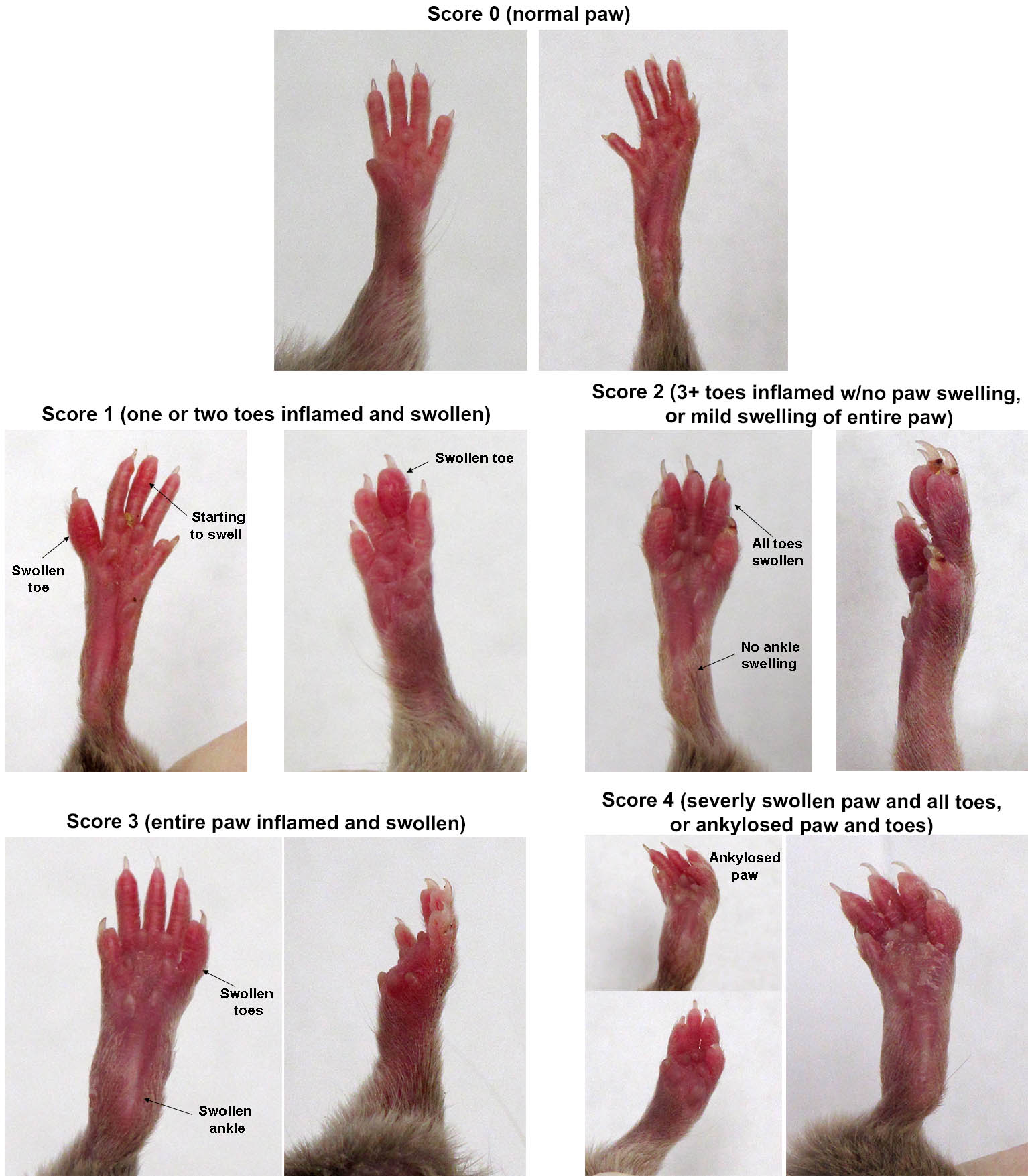
We recommend scoring CIA on the scale of 0 to 16 (0 to 4 for each paw, adding the scores for all 4 paws), using the following criteria:
| Paw score | Clinical observations |
|---|---|
| 0 | Normal paw. No obvious differences in appearance vs. healthy mice. |
| 1 | One or two toes inflamed and swollen. No apparent swelling of paw or ankle. |
| 2 | Three or more toes inflamed and swollen, but no paw swelling, OR Mild swelling of entire paw. |
| 3 | Swelling of entire paw. |
| 4 | Severe swelling of entire paw and all toes, OR Ankylosed paw and toes and the mouse cannot grip the wire top of the cage. |
CIA scoring - typical mouse paw appearance
Expected results
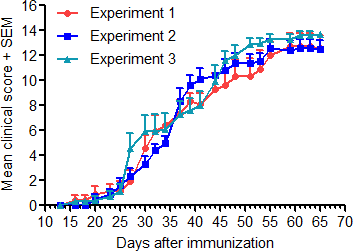
CIA is consistently induced 20 to 35 days after immunization in 90 to 100% of male mice, in 90 to 100% of female mice using chicken collagen, and in 60 to 100% of female mice using bovine collagen.
Maximum severity for most mice will be 10 to 14 (on the scale of 0 to 16).
Up to 20% of mice may show signs of CIA before Day 21 after immunization.
The following illustrates typical results using collagen/CFA with a collagen/IFA booster:
CIA induction in DBA/1 mice – collagen/CFA, collagen/IFA booster
| Exp # | # mice | Age at immunization |
Mean maximum score ± SD |
Day of onset ± SD |
Disease incidence |
|---|---|---|---|---|---|
| 1 | 7 | 7 weeks | 12.71 ± 3.98 | 26.3 ± 6.2 | 100 % |
| 2 | 8 | 8 weeks | 12.63 ± 3.24 | 24.4 ± 3.9 | 100 % |
| 3 | 7 | 8 weeks | 13.71 ± 3.72 | 23.7 ± 5.6 | 100 % |
Protocol: CIA Induction in DBA/1 Mice
Data are from three independent experiments using Hooke Kits™ Chicken Collagen/CFA Emulsion (EK-0210) and Chicken Collagen/IFA Emulsion (EK-0211), with female DBA/1 mice (Taconic Biosciences).
Similar results are obtained using Bovine Collagen/CFA Emulsion (EK-0220) and Bovine Collagen/IFA Emulsion (EK-0221) in male DBA/mice (Taconic Biosciences).
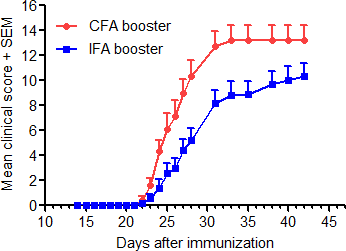
For stronger CIA with earlier onset, use a booster dose containing collagen/CFA (instead of collagen/IFA). The graph below presents a comparison between CFA and IFA-containing boosters:
CIA induction in DBA/1 mice - CFA vs. IFA booster
| Group | # mice | Age at immunization |
Mean maximum score ± SD |
Day of onset ± SD |
Disease incidence |
|---|---|---|---|---|---|
| CFA booster | 10 | 9 weeks | 13.20 ± 3.79 | 23.6 ± 1.5 | 100 % |
| IFA booster | 9 | 9 weeks | 10.33 ± 1.09 | 25.2 ± 2.8 | 100 % |
Data obtained using Hooke Kits™ Bovine Collagen/CFA Emulsion (EK-0220) and Bovine Collagen/IFA Emulsion (EK-0221) in male DBA/mice (Taconic Biosciences).
Version: 2023-10
_150px.jpg)